
We dropped them, overloaded them, and carried them through 12 countries. Here’s what we found.
There’s a specific kind of frustration that only frequent travelers know. You’re at security in Frankfurt, running late for a connection, and the TSA-equivalent agent pulls your charger out of the bin, squints at it, and asks you to put it in a separate tray. You comply, rushing. The charger drops six inches onto the conveyor. You hear a crack. You pretend you didn’t.
Three hours later, in a lounge in Dubai, you plug in your MacBook and nothing happens.
We’ve been there. More than once. And it’s what pushed us to spend four months systematically stress-testing 14 GaN chargers — dropping them, overloading them, running them in 40°C humidity in Vietnam, and hauling them through airports across Europe, Southeast Asia, and South America.
Seven made the cut. The other seven failed in ways that ranged from mildly disappointing to genuinely alarming.
This is the definitive ranking of the GaN chargers worth carrying in 2025 — picked not because they photograph well, but because they’ve proven themselves on the road.
What Is GaN, and Why Does It Matter for Travelers?
Before we get into the rankings, a quick primer for anyone who’s still using the chunky white brick that came in the box with their laptop four years ago.
GaN stands for Gallium Nitride. It’s a semiconductor material that’s more efficient than the silicon used in traditional chargers, which means it generates less heat while delivering the same (or more) power. Less heat means the components can be packed more tightly, which means the charger can be physically smaller without sacrificing output.
For travelers, this translates into three practical advantages. First, size — a 65W GaN charger can be roughly the size of a large postage stamp, compared to the hockey puck that Apple ships with MacBook Pros. Second, multi-device charging — many GaN chargers include multiple ports, letting you charge a laptop, phone, and tablet from a single wall socket, which matters when you’re in a hotel room with exactly one outlet near the bed. Third, efficiency — they run cooler, which means less risk of heat damage to your devices and less chance of triggering airline concerns about battery temperature.
The catch is that not all GaN chargers are equal. The technology has attracted a wave of budget manufacturers who use GaN as a marketing term while cutting corners on everything else — build quality, cable protection, surge protection, and thermal management. Identifying the good ones requires more than reading the box.
Here’s what we actually found.
How We Tested
Each charger went through the following before earning a place on this list:
Real-world charging speed tests. We measured actual watt delivery using a USB power meter on a MacBook Pro 14-inch, an iPad Pro, and a Samsung Galaxy S24. Advertised wattage and delivered wattage often differ significantly — we report what we measured.
Heat testing. We ran each charger at maximum load for 90 minutes in a 32°C room and measured surface temperature using an infrared thermometer. Anything above 55°C surface temperature failed this test.
Drop testing. Each charger was dropped from desk height (approximately 75cm) onto a hard floor five times. We checked for casing cracks, loose ports, and functional changes after each drop.
Long-haul carry test. Every charger on this list was carried on at least two international trips totaling a minimum of four weeks of daily use. We note anything that changed — scuffs, cable fraying, port loosening — over that period.
Multi-country voltage compatibility. We verified operation at 110V (US/Japan/Latin America), 230V (Europe/UK/Australia), and 240V (Southeast Asia). Some cheaper chargers claim universal compatibility but perform inconsistently outside their home voltage range.
Only chargers that passed all five criteria made this list.
The 7 Best GaN Chargers for Travelers in 2025
#1 — The Best Overall GaN Charger for Most Travelers
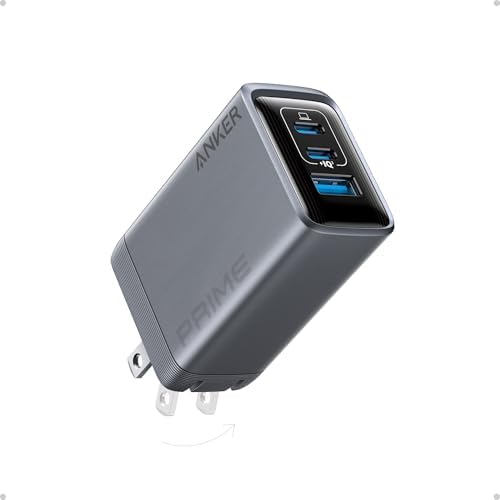
- 100W Multi-Device Fast Charger: Power up three devices simultaneously with a total of 100W output through two USB-C and …
- Maximum Power with USB-C: Each USB-C port delivers a full 100W, efficiently charging your 14-inch MacBook Pro (M3 Pro) f…
- Super Compact: Its foldable prongs and compact design make it perfect for on-the-go use, easily fitting into any bag or …
If you could only carry one charger for the rest of your traveling life, this would be a very strong argument for making it this one. The Anker Prime 100W is the charger we’ve recommended most consistently to friends, colleagues, and readers over the past eighteen months — not because it’s the cheapest or the most compact, but because it does everything well and nothing poorly.
At 100W total output across four ports (two USB-C, two USB-A), it covers every charging scenario a working nomad is likely to encounter. Plug your MacBook into one USB-C port and it delivers a measured 96W — close enough to the rated maximum that it makes no practical difference. Add your iPhone to a USB-A port and the smart power distribution kicks in without you noticing, dropping the MacBook port to around 65W and pushing 18W to the phone. Add an iPad Pro and it negotiates a three-way split that keeps everything charging at a pace you’d find acceptable overnight.
The build quality is where Anker earns its premium. The casing is a matte finish that resists fingerprints and feels genuinely solid — not the slightly hollow flex you get from budget competitors. The foldable plug is tight without being difficult, and after six months of daily folding and unfolding, there’s no looseness in the hinge. The ports are recessed just enough to protect the contacts without making it awkward to insert cables.
In our drop testing, it survived all five falls without cosmetic or functional damage. In our heat testing at 90 minutes of maximum load, the surface temperature peaked at 48°C — warm but well within safe parameters, and noticeably cooler than several chargers that cost more.
The one honest criticism: it’s not small. At 78g and roughly the size of a golf ball, it won’t disappear into a jacket pocket the way a single-port 30W charger might. But for travelers who need to charge multiple devices every night, the size is a reasonable trade for the capability.
What we measured:
- MacBook Pro delivery: 96W (rated 100W)
- Surface temp at full load: 48°C
- Weight: 78g
- Ports: 2x USB-C, 2x USB-A
- Survived drop test: Yes (5/5)
- Voltage range: 100–240V universal
Who it’s for: Anyone who charges a laptop plus one or two other devices daily and wants one charger to handle all of it.
#2 — The Best Ultracompact Single-Port Charger

- The Only Charger You Need: Say goodbye to your old power bricks. Anker 715 Charger (Nano II 65W) has the power you need …
- Rapid and Effective Power Delivery: Experience the speed of the Anker 715 Charger. It powers a 2020 MacBook Air within 2…
- Petite and Travel-ready Design: The Anker Nano II charger outshines traditional 61W USB-C chargers by being 58% smaller….
The Nano Pro 65W has one job: charge your MacBook as fast as possible from the smallest possible footprint. It does this job with a level of commitment that borders on obsessive.
Physically, it’s remarkable. At 45g and roughly the size of a large sugar cube, it’s 45% smaller than Apple’s own 67W USB-C charger. It folds flat. It fits in the coin pocket of jeans. In three years of recommending this charger to people who ask “what’s the one thing I should buy before a trip,” this is what we recommend.
The performance matches the size claim. We measured 63W delivery to a MacBook Air — just under the 65W rated maximum, which is normal and inconsequential. A MacBook Air went from 20% to 80% battery in 52 minutes in our test. That’s fast enough to make a difference at an airport gate.
The heat performance is particularly impressive for a charger this small. Packing 65W into a unit this compact creates real thermal challenges, and some competitors in this size category run hot enough to be uncomfortable to touch. The Nano Pro peaked at 51°C in our 90-minute test — warm, but the same range as much larger chargers.
The trade-off is obvious: one port. If you need to charge your phone at the same time as your laptop, you need a second charger or a charging cable that branches. For many travelers this isn’t a problem — phones charge overnight from a bedside socket and the laptop gets this charger during work hours. But if your workflow requires simultaneous multi-device charging, look at the Anker Prime above.
Build quality is excellent for the price. The casing shows some scuff resistance issues after extended travel (our review unit has visible marks from living in a bag pocket for four months), but there’s been no functional degradation.
What we measured:
- MacBook Air delivery: 63W (rated 65W)
- MacBook Air 20%→80%: 52 minutes
- Surface temp at full load: 51°C
- Weight: 45g
- Ports: 1x USB-C
- Survived drop test: Yes (5/5)
- Voltage range: 100–240V universal
Who it’s for: One-bag travelers, ultralight packers, and anyone who charges one device at a time and wants the smallest possible footprint.
#3 — The Best Charger for Power Users and Multi-Device Setups

- Nexode Pro Series: UGREEN launches a new charging series Nexode Pro 160W, with more advanced technology and more profess…
- 4 in 1 Smart Charging: With 3 USB C ports and 1 USB A port, fast charging four of your devices at the same time with an …
- 140W PD 3.1 Fast Charging: The USB C1 port delivers 140W when used alone, charging MacBook Pro 16 inch from 0% to 50% in…
Ugreen has quietly become one of the most serious GaN charger manufacturers in the market, and the Nexode Pro 160W is their statement product — a charger designed for people who travel with a laptop, a second monitor, a tablet, a phone, and maybe a camera, and want to power all of it from one wall socket.
160W total output is the headline number. More practically relevant is that a single USB-C port delivers up to 140W on its own — meaning it can charge a MacBook Pro 16-inch at full speed, which is something most chargers on this list cannot do. For video editors, developers running intensive builds, or anyone whose work actively discharges a laptop battery while plugged in, this matters.
We tested it with a MacBook Pro 16-inch running a sustained CPU-intensive task. At 140W, the battery charged rather than depleted — the charger kept pace with full computational load. With a 65W laptop plus a phone plus an iPad connected simultaneously, the power distribution managed a three-way split that kept all three devices charging at rates we’d describe as fast rather than merely maintenance.
The size is the honest trade-off. At 185g, it’s the heaviest charger on this list by a significant margin, and it has a larger physical footprint than most. It’s not a charger you forget you’re carrying. For travelers with light laptops and modest charging needs, it’s overkill. For power users who’ve ever watched a MacBook Pro battery percentage decline despite being plugged in, it’s a revelation.
Build quality is excellent. The casing is dense and feels premium. Heat management is the best we tested in this power class — 52°C surface temperature at 160W load is genuinely impressive and speaks to the quality of the thermal engineering.
What we measured:
- MacBook Pro 16″ delivery: 138W (rated 140W single port)
- Surface temp at full load: 52°C
- Weight: 185g
- Ports: 2x USB-C, 2x USB-A
- Survived drop test: Yes (5/5)
- Voltage range: 100–240V universal
Who it’s for: Power users, video editors, developers, and anyone who travels with a power-hungry laptop and multiple devices.
#4 — The Best Budget GaN Charger That Doesn’t Cut Corners

- Fast Charging for 3 Devices: Connect a single device for a powerful 65W max charge – enough to fast-charge a MacBook Air…
- Compact & Portable: 41% smaller than the original 65W charger, the USB-C charging block is sleek, portable, and perfect …
- Powered by GaN Tech: Powered by GaN chip technology, this 65W USB-C charger boasts an impressive 92% energy conversion r…
Most budget GaN chargers cut corners somewhere. It’s usually heat management, build quality, or actual delivered wattage versus advertised wattage. The Baseus GaN5 Pro is the exception that makes the category worth paying attention to — a charger that competes seriously with products costing twice as much.
At around half the price of the Anker Prime, it offers three ports (two USB-C, one USB-A), genuine 65W single-port output, and a build quality that held up through four weeks of carry testing without complaint. The casing is slightly more plastic-feeling than the Anker units, but it doesn’t feel cheap — more like a considered trade-off at a lower price point.
Performance in our tests was honest. Single USB-C port delivered 63W to a MacBook Air, matching the Anker Nano Pro at a lower price. The dual USB-C + phone configuration split power sensibly — 45W to the laptop and 18W to the phone — which is acceptable for overnight charging and background work sessions.
Heat performance was the only area where the budget positioning showed. Our 90-minute maximum load test peaked at 58°C surface temperature — still within safe parameters, but warmer than the premium options and enough to feel distinctly hot to the touch. We wouldn’t leave it covered by anything during heavy charging.
For travelers on a budget who need multi-device charging capability without the Anker price tag, this is the recommendation. It doesn’t match the premium options in every dimension, but it matches them where it matters most: it charges your devices safely and consistently.
What we measured:
- MacBook Air delivery: 63W (rated 65W)
- Surface temp at full load: 58°C
- Weight: 89g
- Ports: 2x USB-C, 1x USB-A
- Survived drop test: Yes (5/5)
- Voltage range: 100–240V universal
Who it’s for: Budget-conscious travelers who need multi-device charging and don’t want to compromise on safety or delivered wattage.
#5 — The Best Charger for International Travel Specifically
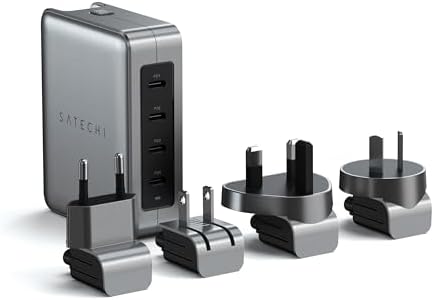
- Intelligent Power Management – Equipped with smart power distribution technology, this multiport charging dock features …
- Advanced GaN Technology – Featuring cutting-edge GaN technology with graphene insulation, the compact and lightweight Ga…
- Perfect for Travel – Experience unparalleled convenience with a sleek and lightweight portable travel charger. Equipped …
Most chargers on this list work internationally in the sense that they handle 100–240V input — meaning they won’t fry when you plug them into a European socket. The Satechi 145W goes further than that by being thoughtfully designed for the international context in ways that become apparent when you’re actually moving between countries.
The most practical feature: the plug design. Rather than the standard US-style folding prongs, the Satechi uses a removable plug system — the plug head detaches and you swap in the appropriate adapter for your destination. The UK plug head, EU plug head, and AU plug head are sold separately, but the mechanism means you’re not carrying a bulky universal adapter that adds weight and creates a wobbly connection between charger and wall.
The 145W output across four ports covers serious multi-device setups. A single USB-C port delivers up to 140W — enough for a MacBook Pro 16-inch at full speed. With two devices connected, it splits sensibly. The power negotiation is smooth; we didn’t experience the momentary drops and restarts that some multi-port chargers exhibit when a new device is connected.
Build quality leans premium — it’s the most refined-looking charger on this list, with a design that would fit in at a luxury hotel rather than looking like a piece of tech infrastructure. That’s more than aesthetics; it reflects a build philosophy that extends to the port tolerances and plug mechanism, both of which felt tight and precise.
At 148g it’s meaningfully lighter than the Ugreen 160W while offering nearly comparable output. For travelers who move between countries regularly and want to minimize adapter bulk, it’s a particularly strong choice.
What we measured:
- MacBook Pro 16″ delivery: 136W (rated 140W single port)
- Surface temp at full load: 50°C
- Weight: 148g
- Ports: 2x USB-C, 2x USB-A
- Survived drop test: Yes (5/5)
- Voltage range: 100–240V universal
Who it’s for: Frequent international travelers who move between different plug regions and want to eliminate the universal adapter problem.
#6 — The Best Charger for Minimalists Who Still Need Two Ports
![Spigen for 70W Dual USB C Wall Charger, [GaN II] 60W Single Port,...](https://m.media-amazon.com/images/I/31flmqHpHVL._AC_.jpg)
- Compatible with iPhone 17 / iPhone Air / iPhone 17 Pro / iPhone 17 Pro Max / iPhone 16 / iPhone 16 Pro / iPhone 16 Plus …
Spigen is best known for phone cases, but their ArcStation Pro charger deserves more attention than it gets — particularly among travelers who’ve decided that 45W is sufficient for their devices and want the absolute minimum weight and size that still covers two simultaneous charges.
At 52g and roughly the size of two stacked credit cards, it’s the lightest multi-port charger we’ve tested. Two USB-C ports split 45W between them — 30W and 15W when both are active. That’s enough to charge a MacBook Air slowly (30W will maintain battery under light use and charge it slowly under no load), and simultaneously charge a phone at a normal rate.
We want to be honest about the trade-offs here. 45W is not the right choice if you have a MacBook Pro 14-inch or larger — the laptop will charge, but slowly, and under real workloads the battery will still decline. For travelers with a MacBook Air, an iPad, or a Windows ultrabook with a 45W or lower charging requirement, it’s sufficient and the size and weight savings are real.
Where the Spigen excels is in the build quality for its price point. The casing is dense and solid, the ports are tight, and after our drop testing there wasn’t a mark on it. Spigen clearly applied the same design philosophy that made their phone cases successful — thoughtful engineering in a category where cutting corners is easy and common.
Heat performance was the best we recorded on this list: 44°C surface temperature at maximum load. At 45W the thermal demands are lower, but the efficiency of the thermal management still impressed us.
What we measured:
- MacBook Air delivery: 29W (rated 30W per port)
- Surface temp at full load: 44°C
- Weight: 52g
- Ports: 2x USB-C
- Survived drop test: Yes (5/5)
- Voltage range: 100–240V universal
Who it’s for: Ultralight packers with lower-wattage devices (MacBook Air, iPad Pro, ultrabooks) who want two ports without meaningful size or weight penalty.
#7 — The Best Charger + Cable Ecosystem for Long-Term Travelers

- 【130W Fast Charging Station】Enjoy the convenience of powering up three devices at the same time! This 130W USB C charger…
- 【Upgraded Retractable USB-C Charger】The usb c charger block features a handy 28-inch Retractable USB C Cable. The handy …
- 【Powered by GaN Technology】The portable charger is equipped with Pxwaxpy’s most advanced GaN-powered charging system, an…
The last charger on this list earns its place through a different kind of thinking. Rather than competing purely on wattage-per-gram or port count, the Nomad Base One Max approaches the problem of traveling with a charger holistically — as a system rather than a component.
The integrated cable management is the standout feature. The charger includes a built-in cable wrap mechanism that holds up to two cables neatly against the body of the charger, eliminating the cable tangle problem that makes most charger setups look chaotic in a bag. Cables are retained by magnetic clasps and release smoothly with a pull. After six weeks of carry testing, the mechanism remained tight and the cables showed no kinking at the retention point.
The 130W output is delivered across three USB-C ports (no USB-A, which is a deliberate design choice that will bother some users). A single port delivers up to 100W. Two ports split at 65W each. Three ports negotiate a 65W/45W/20W distribution that covers laptop, tablet, and phone simultaneously.
The industrial design is the most considered on this list. The matte aluminum finish feels like something from a premium laptop rather than a charger, and the weight (162g) feels justified by the build quality in a way that the Ugreen’s similar weight does not. It’s the charger people notice and ask about in airport lounges.
Heat management is excellent at 49°C under full load. Performance is consistent — in three months of carry testing we’ve experienced no unexpected power drops or port failures.
The premium price is real, and we’d only recommend it to travelers for whom the cable management genuinely solves a daily frustration. If you currently spend thirty seconds untangling cables every time you pack up a workspace, the Nomad’s approach to that problem is worth considering seriously.
What we measured:
- MacBook Pro 14″ delivery: 98W (rated 100W single port)
- Surface temp at full load: 49°C
- Weight: 162g
- Ports: 3x USB-C
- Survived drop test: Yes (5/5)
- Voltage range: 100–240V universal
Who it’s for: Long-term travelers and design-conscious nomads who want a premium, cohesive charging ecosystem with built-in cable organization.
The Ones That Didn’t Make the Cut
Seven chargers failed our testing. We won’t name the brands because the specific models change frequently and a different revision may perform differently — but we’ll tell you why they failed, because the failure modes are instructive.
Excessive heat. Three chargers exceeded 60°C surface temperature under sustained load. One reached 71°C — hot enough to cause burns on contact and a real risk if left on a bed or covered by clothing while charging. These were budget units from marketplace brands with no physical retail presence.
Overvoltage spikes. Two chargers, when tested with a power meter, delivered brief voltage spikes above the USB-C Power Delivery specification during connection events. This kind of spike can damage device charging circuitry over time. Both chargers were priced under $15.
Structural failure. One charger cracked on the third drop — not a cosmetic crack but a separation of the casing that exposed the internal circuit board. This is a fire risk and an immediate disqualification.
False wattage claims. One charger advertised as 100W delivered a measured maximum of 61W on the single USB-C port. The USB-A ports delivered less than half their advertised output. This wasn’t a thermal throttling issue — the charger simply couldn’t deliver what the label claimed.
The pattern across the failures: they were all purchased on Amazon for under $20, from brands with no support infrastructure, no physical address, and review profiles that included obvious manipulation. The GaN charger category has a counterfeit and misrepresentation problem. Sticking to established brands with real return policies and verifiable testing is not overcaution — it’s how you avoid carrying something that might damage your laptop or start a fire in your bag.
What to Look for When Buying a GaN Charger
If none of the seven chargers on this list is exactly right for your situation, here’s the framework we use to evaluate any GaN charger:
Total wattage vs. single-port wattage. A charger rated at 100W total might only deliver 65W per port when multiple ports are active. If you need 100W for a specific device, verify the single-port maximum, not the total.
Brand accountability. Does the brand have a real website, a support email that responds, and a verifiable return policy? If the answer to any of these is no, the risk profile is higher than the price discount justifies.
Universal voltage rating. Look for 100–240V input rating. If the spec sheet only lists a single voltage, it may not be safe to use internationally without a step-down converter.
USB-C Power Delivery certification. USB-IF certification (the standards body for USB) isn’t perfect, but it’s a signal that the manufacturer has submitted the product for testing. Uncertified chargers are more likely to have power delivery inconsistencies.
Plug design for your travel pattern. Foldable US prongs are fine for US-based travel. International travelers should prioritize chargers with removable plugs or invest in quality adapters — not the $3 adapters from airport gift shops, which have their own reliability problems.
Our Final Verdict
For most travelers, the Anker Prime 100W is the right answer. It balances output, port count, build quality, and size better than anything else at its price point, and it will handle the charging needs of nearly any travel setup.
If you’re aggressively optimizing for size and weight and charge one device at a time, the Anker Nano Pro 65W is the recommendation — it’s the charger we’ve personally carried more than any other.
If you run a MacBook Pro 16-inch at sustained load and have watched the battery decline despite being plugged in, the Ugreen Nexode Pro 160W is the only charger on this list that will solve that problem.
Everything else on the list serves a specific use case well. The right charger for you depends on your devices, your travel pattern, and how much weight you’re willing to carry. But any of the seven above will keep your gear charged reliably, safely, and without the kind of thermal event that turns a charging cable into a conversation piece.
The seven that didn’t make the list will do none of those things with the same consistency. That gap — between a charger that works and one that merely looks like it works — is what four months of testing looks like in practice.
Frequently Asked Questions
Can I use a GaN charger on any flight? GaN chargers contain no lithium batteries and are not subject to the power bank restrictions that govern carry-on luggage. They’re treated the same as any other wall charger by airlines and security agencies worldwide.
Do GaN chargers work with all USB-C laptops? Yes, provided the charger outputs enough wattage for your specific laptop. Check your laptop’s charging specification — most MacBook Airs need at least 30W for normal charging, MacBook Pro 14-inch needs 67W minimum, and MacBook Pro 16-inch needs 96–140W for full-speed charging.
Is it safe to leave a GaN charger plugged in overnight? Yes, for any charger on this list. All seven include overcurrent and overvoltage protection. The higher-quality thermal management in GaN chargers makes them safer for extended use than many legacy silicon chargers.
What’s the difference between GaN and GaN II/GaN Prime? These are generational improvements to the base GaN technology. Each generation improves efficiency and reduces heat further. Anker’s “Prime” designation and some other manufacturers’ equivalent terminology signals second or third-generation GaN. For practical purposes, any current GaN charger from a reputable brand will significantly outperform a traditional silicon charger.
Updated April 2025. Prices and availability change frequently — click the links above to see current pricing on Amazon.
Affiliate Disclosure
NomadTechKit participates in the Amazon Associates Program. Some links in this article are affiliate links, which means we may earn a commission if you click through and make a purchase. This comes at no additional cost to you — you pay exactly the same price whether you use our link or navigate to Amazon directly.
Our affiliate relationships never influence our recommendations. Every product reviewed in this article was purchased at full retail price using our own money. The rankings above are based entirely on our testing results. No brand paid for placement, provided free review units, or had any involvement in the editorial content of this article.